



Source: Untar Public Relations
Inequality in the enforcement of tax crime laws in Indonesia continues to face issues of substantive justice. In practice, legal proceedings often target only those formally listed within a company’s structure, such as formal directors, nominees, or employees. Meanwhile, individuals who actually control the company and benefit from tax crimes have not been fully brought within the reach of legal processes.
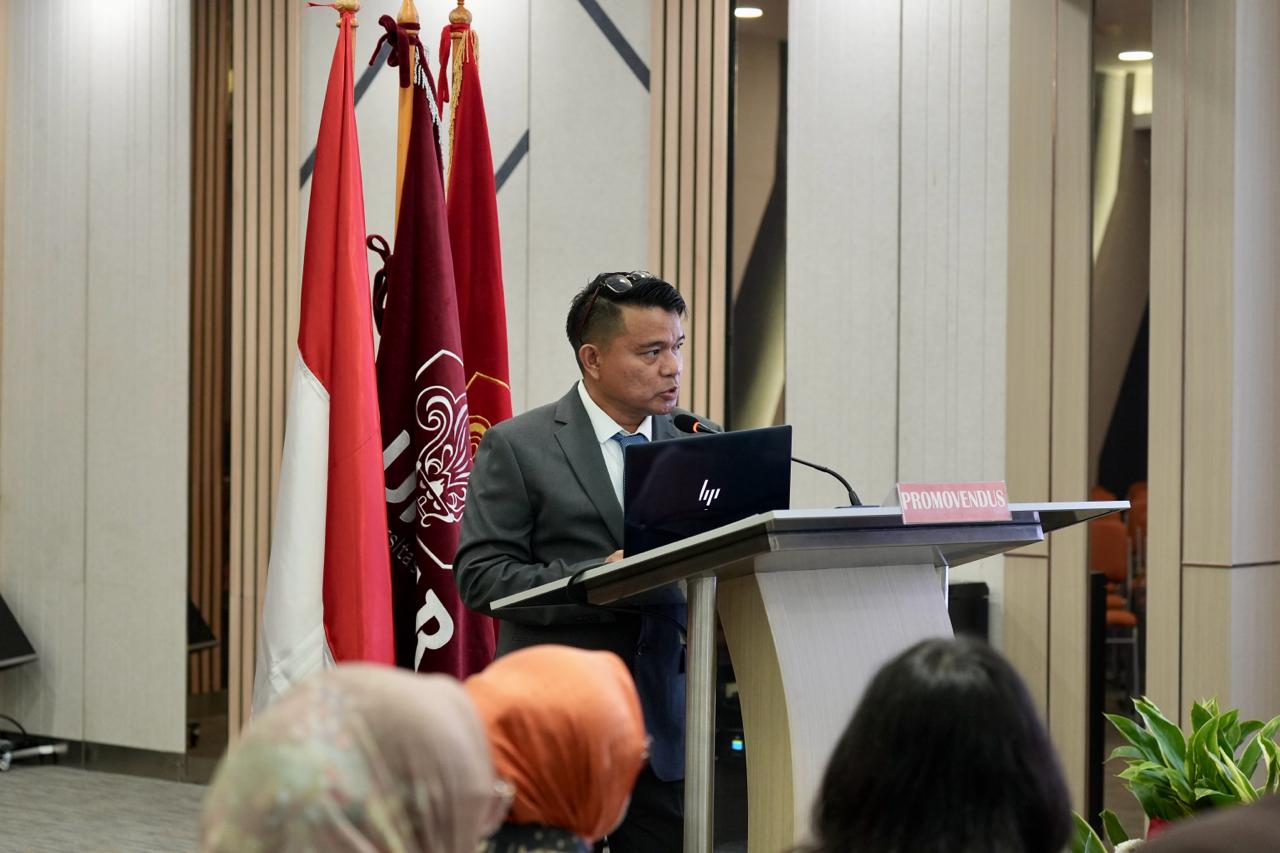
This issue formed the basis of Nopriyandi’s dissertation titled “Beneficial Owner as an Expansion of Legal Subjects in Tax Crimes Based on the Principle of Justice”, which he defended during the open examination of the Doctoral Program in Law at Universitas Tarumanagara (Untar) on Friday (05/06/2026) at Campus I of Untar.
Nopriyandi, who currently serves as a Senior Prosecutor (IV/c) at the Special Unit for Special Crimes of the DKI Jakarta High Prosecutor’s Office, officially became the 63rd doctoral graduate of the Doctoral Program in Law at Untar, earning a Grade Point Average (GPA) of 3.99 and graduating with cum laude honors.
In his presentation, the doctoral candidate emphasized the importance of expanding the scope of legal subjects in tax crimes by incorporating the concept of the beneficial owner as the party that substantively controls and derives economic benefits from such crimes. This approach is viewed as an effort to address the limitations of law enforcement, which has traditionally focused more on formal perpetrators.
He explained that the concept is grounded in the principles of distributive justice, commutative justice, and due process of law, employing a progressive interpretation of Article 43 of the Law on General Provisions and Tax Procedures (Undang-Undang Ketentuan Umum dan Tata Cara Perpajakan or UU KUP), particularly through the phrase “other parties.” This approach is expected to strengthen legal certainty while delivering more substantive justice in the enforcement of tax law. (CS/YS)