



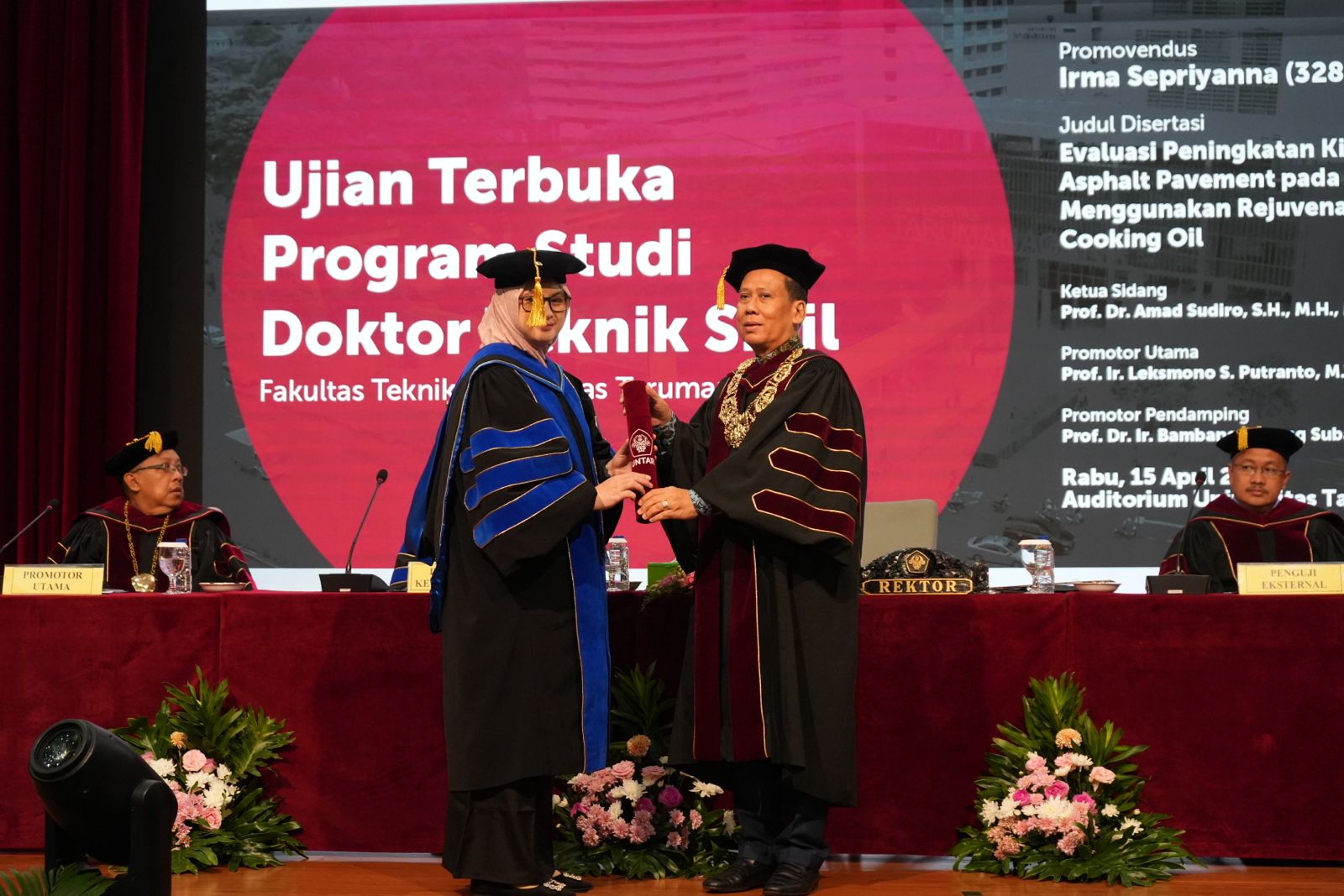
Source: Untar Public Relations – RJ
The Doctor of Civil Engineering Study Program at Untar held an open doctoral examination on Wednesday (15/04/2026) at Untar Campus I. On this occasion, Irma Sepriyanna officially earned the title of the 109th Doctor of Civil Engineering after being declared to have passed with the distinction of highly satisfactory. The graduation was formally confirmed by Rector of Untar, Prof. Dr. Amad Sudiro, S.H., M.H., M.Kn., M.M.
The open examination was attended by university leaders and examiners, including Dean of the Faculty of Engineering Dr. Ir. Wilson Kosasih, S.T., M.T., IPM, ASEAN Eng. The board of examiners consisted of external examiner Dr. Russ Bona Frazila, S.T., M.T., as well as internal examiners Ir. Oei Fuk Jin, S.T., M.Eng., D.Eng. and Dr. Eri Susanto Hariyadi, S.T., M.T. The dissertation was supervised by Main Promoter Ir. Leksmono S.P., M.T., Ph.D., with Co-Promoter Prof. Dr. Ir. Bambang Sugeng Subagio, DEA.
In her dissertation, Dr. Irma Sepriyanna raised the issue of rapidly growing infrastructure development, both nationally and globally. This condition has increased the demand for asphalt, which still largely depends on imports. In addition, the use of binders in asphalt mixtures has the potential to reduce performance, such as causing cracks to develop more quickly.
The research focused on the utilization of waste cooking oil (WCO) as an additive in asphalt production. This utilization was intended not only to improve the quality of the mixture but also as an effort to reduce waste. However, the free fatty acid content in WCO can reduce mixture performance, making a purification process necessary.
As a novelty, the study used WCO purified through a bentonite adsorbent method to serve as a rejuvenator in Reclaimed Asphalt Pavement (RAP). Dr. Irma Sepriyanna also explained the objective of the study: “to obtain the optimum composition for the use of treated WCO and analyze its effect on the physical and mechanical properties of the mixture, such as resistance to permanent deformation, stiffness modulus, and fatigue cracking resistance,” she stated.
Based on the research findings, Dr. Irma Sepriyanna concluded that treated WCO is effective as a rejuvenator in improving RAP performance. This was demonstrated through improvements in chemical properties and molecular structure, enhanced rheological and Marshall performance, better resistance to permanent deformation (rutting), as well as increased resilient modulus and fatigue life. Her dissertation, titled “Evaluation of Performance Improvement of Reclaimed Asphalt Pavement in AUS Layers Using Treated Waste Cooking Oil Rejuvenator,” was successfully defended during the open examination. (VC/YS)