



Source: Untar Public Relations
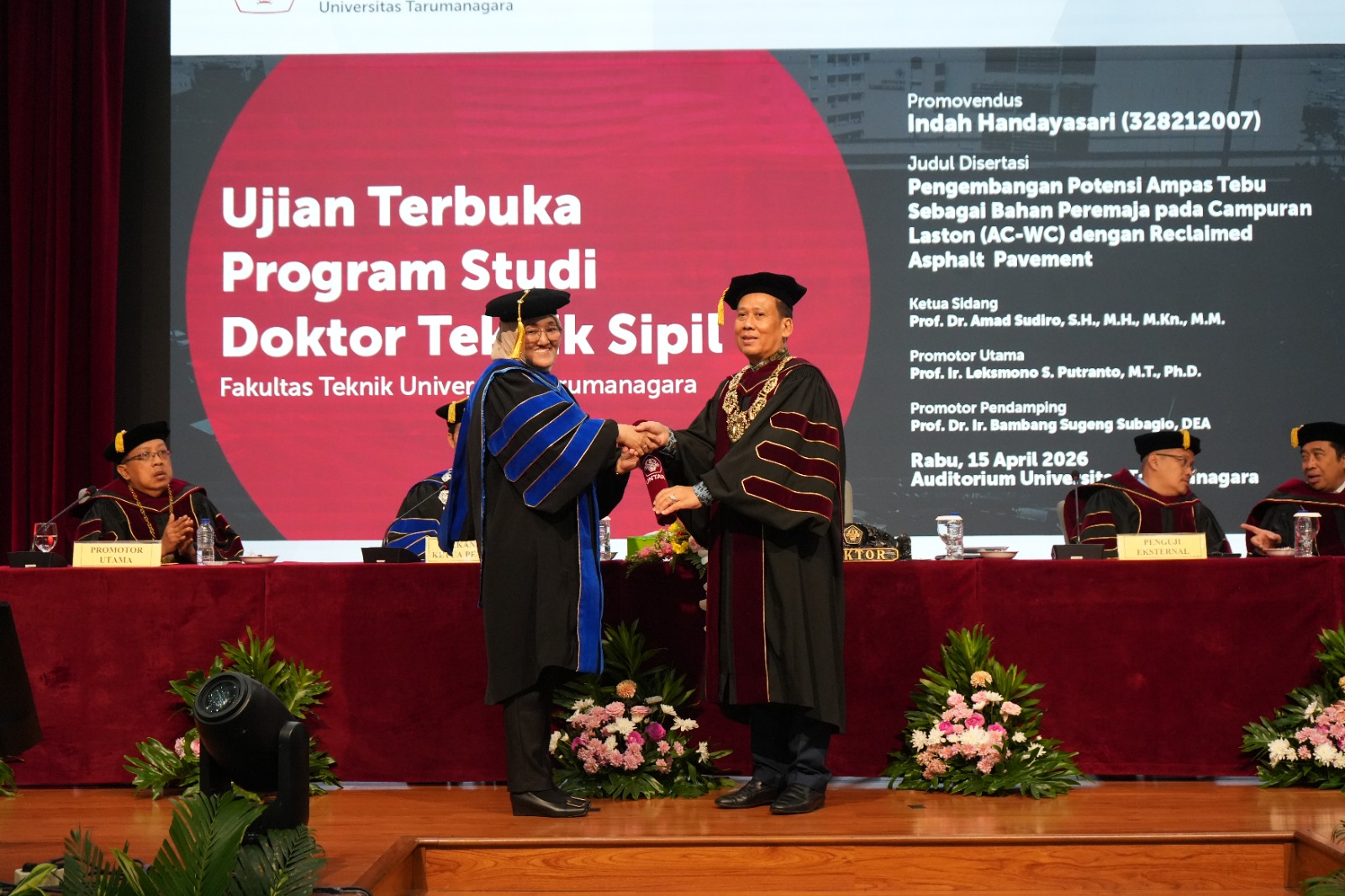
The Doctor of Civil Engineering Study Program under the Faculty of Engineering at Universitas Tarumanagara (Untar) held an open doctoral promotion examination featuring an innovative study titled “Development of Sugarcane Bagasse Potential as a Rejuvenating Agent in Asphalt Concrete Wearing Course (AC-WC) Mixtures with Reclaimed Asphalt Pavement.” The dissertation was defended by Indah Handayasari during an open examination held at the Auditorium of Building M, Untar Campus I, on Wednesday (15/04/2026).
The doctoral promotion examination was chaired by Prof. Dr. Amad Sudiro, S.H., M.H., M.Kn., M.M., with Main Promoter Prof. Ir. Leksmono S. Putranto, M.T., Ph.D., and Co-Promoter Prof. Dr. Ir. Bambang Sugeng Subagio, DEA.
In her research, Indah Handayasari highlighted Indonesia’s high asphalt demand, which still heavily depends on fossil energy sources. The study therefore explored the utilization of sugarcane bagasse biomass as a rejuvenating agent in recycled asphalt technology, or Reclaimed Asphalt Pavement (RAP), to support the development of more environmentally friendly and sustainable road infrastructure.
“The results of this research show that sugarcane bagasse has significant potential to be developed as a rejuvenating material in recycled asphalt mixtures. In addition to improving asphalt mixture performance, the utilization of this biomass can also serve as an alternative that supports sustainable development and waste reduction,” Indah Handayasari stated during the open examination.
According to her findings, bio-asphalt produced through the pyrolysis of sugarcane bagasse possesses hydrocarbon characteristics relatively similar to conventional asphalt. These hydrocarbon contents provide elasticity and viscosity to the material while also improving oxidation resistance. The addition of sugarcane bagasse bio-asphalt was also found to improve asphalt penetration values, enabling them to meet the specifications of Pen 60/70 asphalt used as the control standard.
The research further demonstrated that the Residual Strength Index (RSI) values across all mixture variations met the minimum standard of 90 percent, indicating strong resistance to water-induced damage. In terms of rutting resistance, AC-WC mixtures containing RAP materials and sugarcane bagasse bio-asphalt were proven to perform better than mixtures without RAP in resisting initial deformation, deformation rate, and dynamic stability. (KS/YS) (KS/YS)