



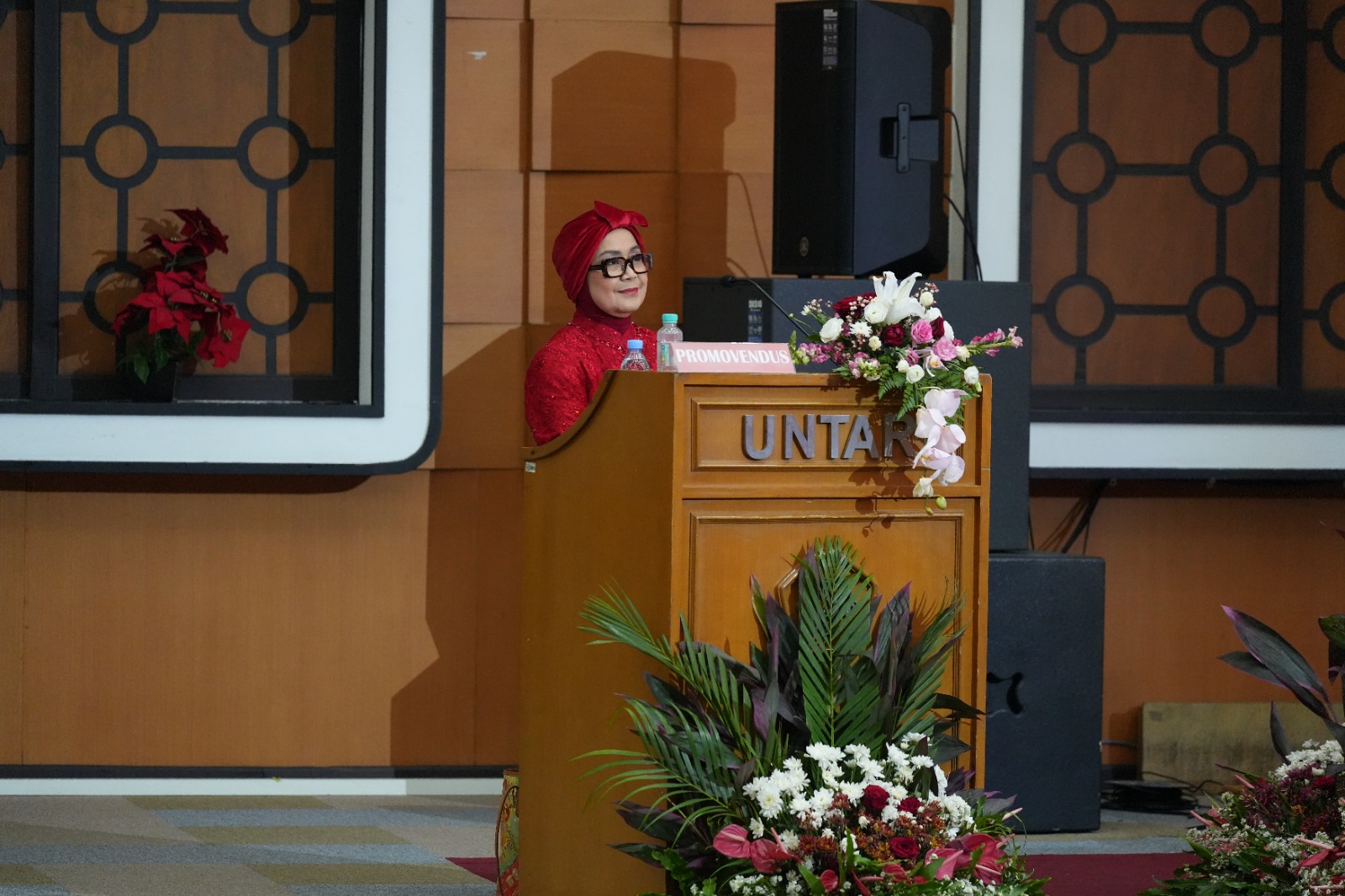
Source: Untar Public Relations
The digital transformation of Indonesia’s business licensing system became a key topic during an Open Doctoral Defense of the Doctoral Program in Law at Universitas Tarumanagara (Untar), held at the Auditorium of Building M, Untar Campus I, on Tuesday (19/05/2026). During the session, promovendus Raita Varia presented her research on the implementation of the Online Single Submission (OSS) system while defending her dissertation entitled “The Role of the Online Single Submission System in Land Transactions by Limited Liability Companies in Relation to Spatial Utilization Conformity in Indonesia.”
The open defense was chaired by Prof. Dr. Amad Sudiro, S.H., M.H., M.Kn., M.M., who also served as the principal promoter, with Prof. Dr. Mella Ismelina F. R., S.H., M.Hum. acting as co-promoter.
The study was motivated by the growing need for legal certainty regarding land ownership and transactions amid expanding economic activities and business development. At the same time, the government introduced the OSS system as part of its effort to simplify business licensing procedures, including the requirement for Limited Liability Companies (Perseroan Terbatas) to obtain Spatial Utilization Activity Conformity (KKPR) approval.
In her presentation, Raita Varia explained that the research examined the issue from philosophical, sociological, and juridical perspectives. Philosophically, the study refers to Article 33 paragraph (3) of the 1945 Constitution, which stipulates that land, water, and natural resources are controlled by the state and utilized for the prosperity of the people. Sociologically, the research highlights that increasing demand for land to support business activities continues to face challenges related to licensing bureaucracy.
“Digitalization through the OSS system should not only simplify licensing procedures but also provide legal certainty and create harmony in sustainable spatial utilization,” Raita Varia stated during the open defense.
Based on the research findings, the OSS system is considered a digital platform capable of aligning land rights transfer processes with national spatial planning policies while ensuring the legality and conformity of business activities. However, its implementation in several regions, including Bekasi City, continues to face challenges ranging from infrastructure limitations and spatial data integration issues to policy disharmony at the local level, which results in variations in procedures and legal certainty across regions.
The study further emphasizes that OSS plays a strategic role as a tool for managing sustainable spatial utilization. Nevertheless, its effectiveness depends heavily on regulatory harmonization, technological readiness, and the capacity of system users to implement and utilize the platform effectively. (KS/YS)