



Source: Untar Public Relations – VC
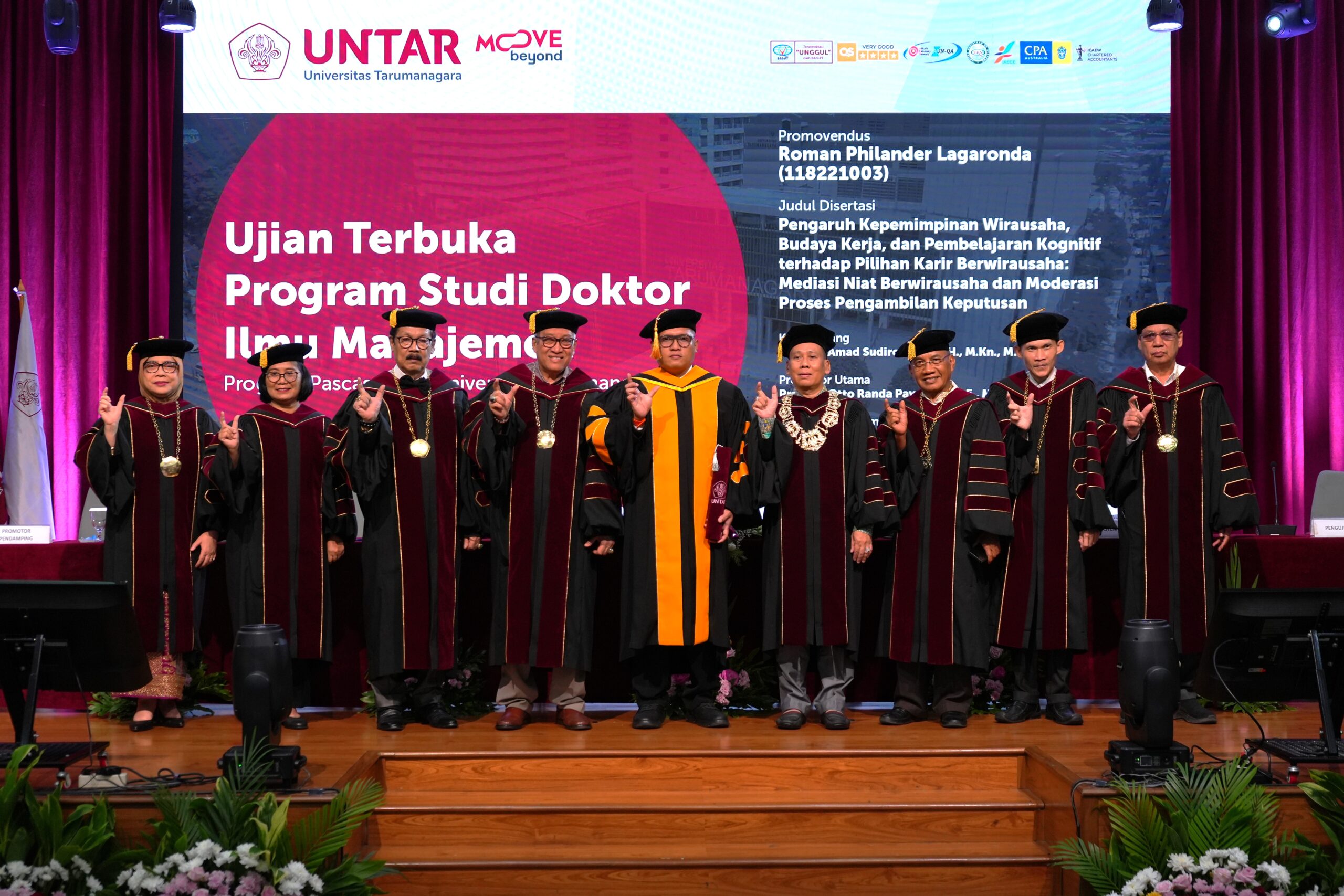
The Doctoral Program in Management at Universitas Tarumanagara (Untar) held an Open Doctoral Promotion Examination at the Auditorium of Building M, Campus I Untar, on Friday (09/01/2026). The open examination also marked Roman Philander Lagaronda as the 22nd Doctor of Management produced by the Doctoral Program in Management at Untar.
The session served as an open examination forum for Roman Philander Lagaronda in defending his dissertation titled “The Influence of Entrepreneurial Leadership, Work Culture, and Cognitive Learning on Entrepreneurial Career Choices: The Mediation of Entrepreneurial Intention and Moderation of Decision-Making Processes.”
The doctoral promotion session was chaired by Untar Rector, Prof. Dr. Amad Sudiro, S.H., M.H., M.Kn., M.M., as Chair of the Session, with Prof. Dr. Otto Randa Payangan, S.E., M.Si. serving as Main Promoter, accompanied by Co-Promoter Dr. Dra. Fransisca Iriani Roesmala Dewi, M.Si.
During the session, Roman presented the strategic role of Micro, Small, and Medium Enterprises (MSMEs), which not only contribute to employment absorption but also serve as the backbone of the national economy. He explained that Papua has significant entrepreneurial potential; however, in practice, business success and entrepreneurial career choices remain uneven, particularly when viewed from differences in MSME behavior between migrant communities and Indigenous Papuans.
“So far, many assistance and training programs have been provided to MSMEs in Papua Province, but most still focus on capital assistance, technical training, and administrative aspects,” Roman stated while explaining the purpose of the research.
The study found that such assistance and training programs have not fully addressed more fundamental factors, including psychological aspects, institutional elements in the form of rules and norms, perspectives shaping entrepreneurial leadership, work culture, cognitive learning, entrepreneurial intention, and decision-making processes.
Using a quantitative approach through surveys involving 450 MSME actors in Jayapura City, Sentani Kota, and Arso Kota, as well as data analysis using the CB-SEM LISREL method, the findings showed that entrepreneurial leadership, work culture, and cognitive learning have a positive and significant influence on entrepreneurial career choices.
Based on these findings, the research indicates that strengthening entrepreneurship in Papua needs to be carried out comprehensively, not only through capital assistance but also through the enhancement of entrepreneurial leadership, work culture, and learning processes among MSME actors. The study further confirms that the entrepreneurial gap between migrant communities and Orang Asli Papua (OAP) is influenced by psychological and institutional factors. Therefore, more contextual training programs, stronger decision-making capabilities, and collaboration among business actors are needed to encourage more equal MSME success in Papua. (KS/YS)