



Source: Untar Public Relations – CS
The energy transition is not only about finding new energy sources, but also about how society builds awareness to use energy more responsibly.
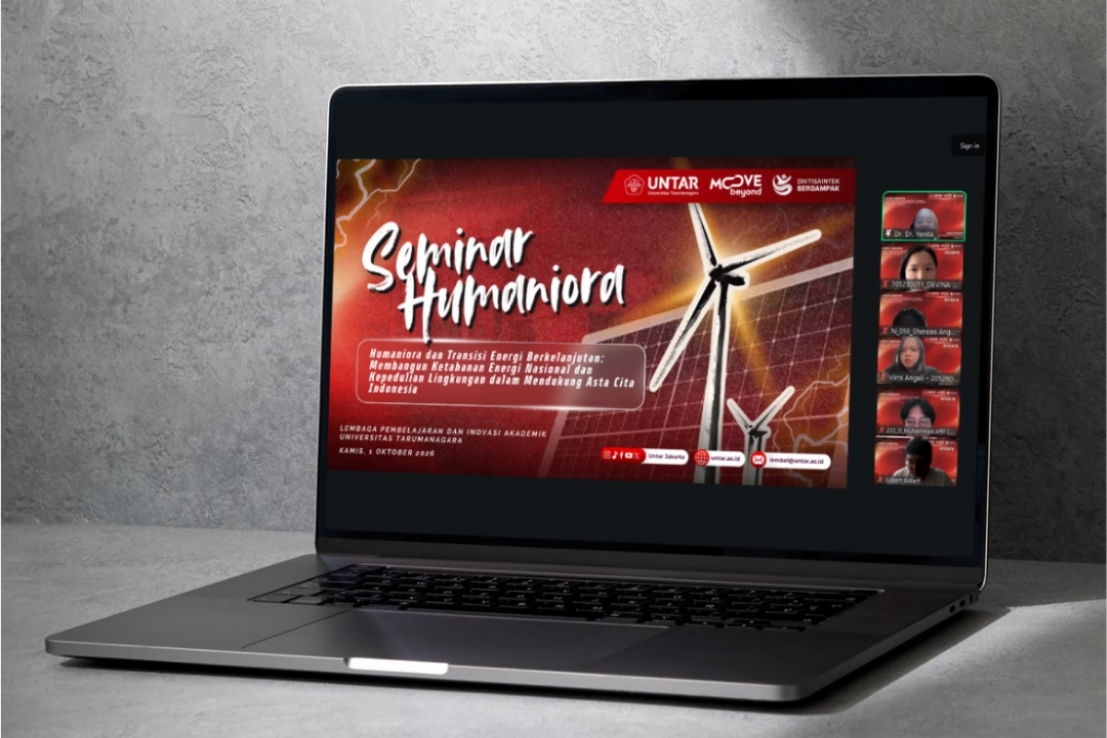
This issue was discussed during the Humanities Seminar 2026 organized by the Institute for Academic Learning and Innovation (Lembel) of Universitas Tarumanagara (Untar) online on Thursday (1/10/2026).
With the theme “Humanities and Sustainable Energy Transition: Building National Energy Resilience and Environmental Awareness in Support of Indonesia’s Asta Cita,” Head of Lembel Untar Dr. Ir. Steven Darmawan, S.T., M.T. explained that the seminar is part of the General Basic Courses (MKDU) based on a humanities approach, encouraging students to produce works that create a tangible impact on society.
Meanwhile, Untar Rector Prof. Dr. Amad Sudiro, S.H., M.H., M.Kn., M.M. emphasized that the energy transition needs to be understood as a process that involves not only technology and policy, but also human behavior.
“The transition toward sustainable energy requires behavioral awareness, ethical use of natural resources, public acceptance, and consideration of intergenerational equity,” he said.
He also added that students have an important role as the generation that will carry out and continue the energy transition process.
The seminar featured Coordinator for Bioenergy Program Preparation, Directorate of Bioenergy, Ministry of Energy and Mineral Resources of the Republic of Indonesia Ira Ayuthia Herdiani, and CEO & President of PT Indopower International Dr. Ir. Harun Al Rasyid, M.M., M.T., Asst. Prof., IPU.
In her presentation, Ira Ayuthia Herdiani discussed “Building National Energy Resilience through Bioenergy Development.” She explained that bioenergy development is an important effort to strengthen national energy resilience while supporting energy source diversification. According to her, the energy transition can run smoothly through cross-sector collaboration involving various stakeholders.
“To ensure the energy transition is implemented optimally, collaboration is needed among State-Owned Enterprises (BUMN) and the private sector, the media, government, academics, non-governmental organizations, and the community,” she explained.
Meanwhile, Harun discussed waste management through a technology-based approach, particularly the thermal treatment process for domestic waste. The discussion highlighted one approach that can be used to manage domestic waste while supporting sustainable environmental management efforts.
The Humanities Seminar serves as a concrete reflection of concern for energy transition issues while upholding national values and encouraging student participation in producing works that can serve as a medium for expanding awareness and creating an impact across Indonesia. (CS/YS)