



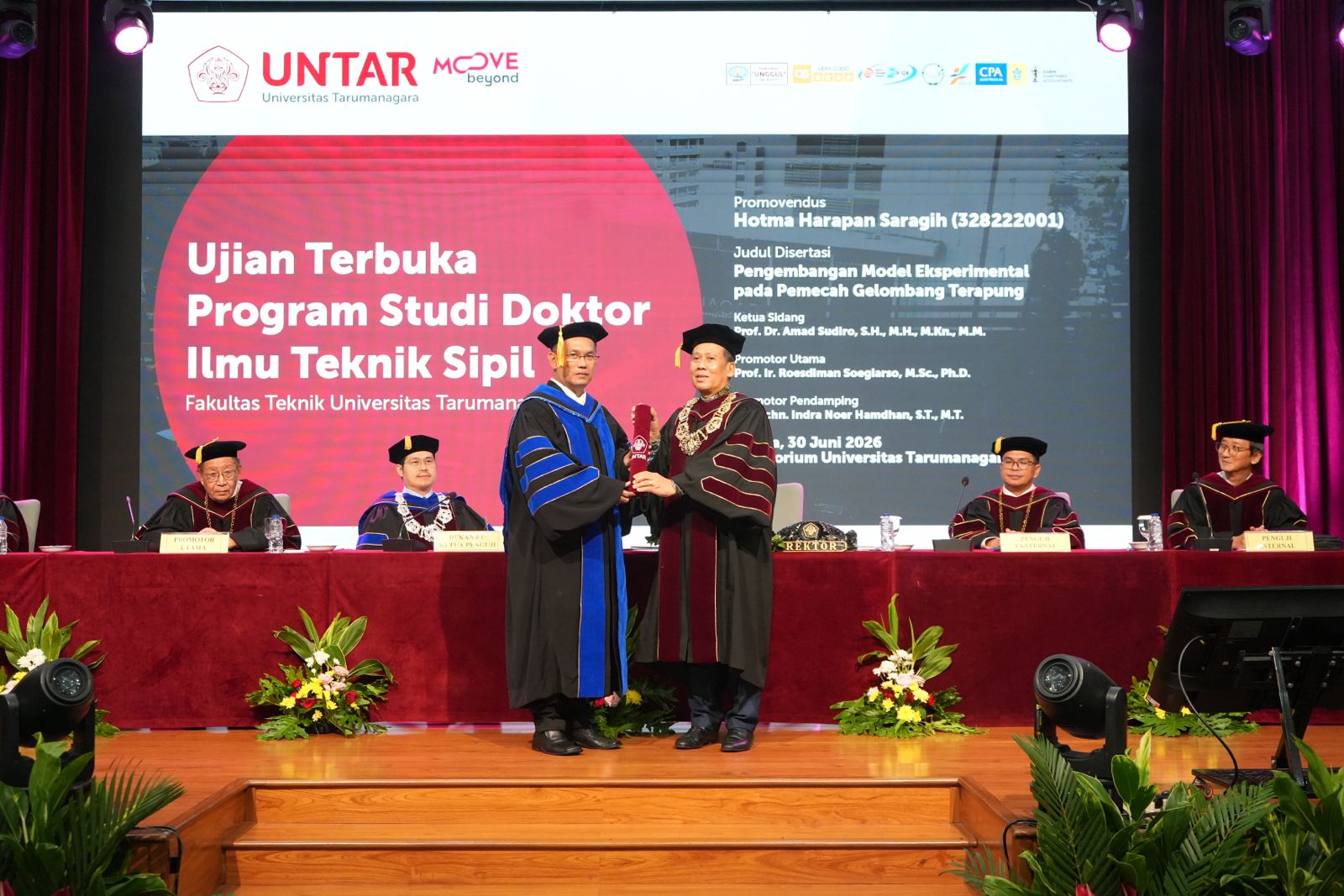
Source: Untar Public Relations – VC
A floating breakwater featuring a wider pontoon and an optimized mooring system has been proven to dissipate wave energy more effectively. The finding was presented by Hotma Harapan Saragih during the open dissertation examination of the Doctor of Civil Engineering Study Program at Universitas Tarumanagara (Untar) on Tuesday (30/6/2026), through his dissertation titled “Pengembangan Model Eksperimental pada Pemecah Gelombang Terapung” (“Development of an Experimental Model for Floating Breakwaters”).
The research was driven by the need for more efficient coastal protection technology, particularly in areas where the construction of conventional breakwaters is not feasible. The study focused on developing a floating breakwater model and its mooring system to reduce wave energy transmission under various water conditions.
Using a combination of laboratory experiments, hydrodynamic simulations with Flow-3D, and structural and mooring dynamics analyses using MOSES, the research evaluated the influence of pontoon geometry and mooring system configurations on the structure’s ability to attenuate wave energy.
The findings showed that the MUIA model, which features a wider pontoon, produced a lower transmission coefficient (Kt) than the MUIB model, enabling it to dissipate wave energy more consistently. The analysis also revealed that structural motion response, connector forces, anchor pull, and the stress distribution of mooring lines are influenced by wave frequency, highlighting the need for an optimal mooring system configuration.
According to Hotma, a wider pontoon model combined with an optimized catenary mooring configuration delivers superior wave attenuation performance, particularly under low-frequency wave conditions. He also explained that Flow-3D simulations can be utilized during the preliminary design stage but must be calibrated through wave flume testing. Furthermore, the simulation results should be integrated into MOSES analysis to ensure the safety of the mooring system while determining structural reinforcement and monitoring requirements.
The research offers a novel contribution by integrating laboratory experiments, hydrodynamic simulations, and mooring dynamics analysis into a single approach for developing floating breakwaters. The findings are expected to serve as a reference for the development of more effective, safer, and more reliable coastal infrastructure capable of withstanding wave energy, while also enriching the field of coastal engineering research in Indonesia.
Hotma Harapan Saragih successfully defended his dissertation before Principal Promoter Prof. Ir. Roesdiman Soegiarso, M.Sc., Ph.D., Co-Promoter Dr. Tech. Indra Noer Hamdhan, S.T., M.T., and Examination Chair, who is also Untar Rector, Prof. Dr. Amad Sudiro, S.H., M.H., M.Kn., M.M. He graduated with cum laude honors and was conferred as the 111th doctoral graduate of Untar’s Doctor of Civil Engineering Study Program. (VC/YS)