



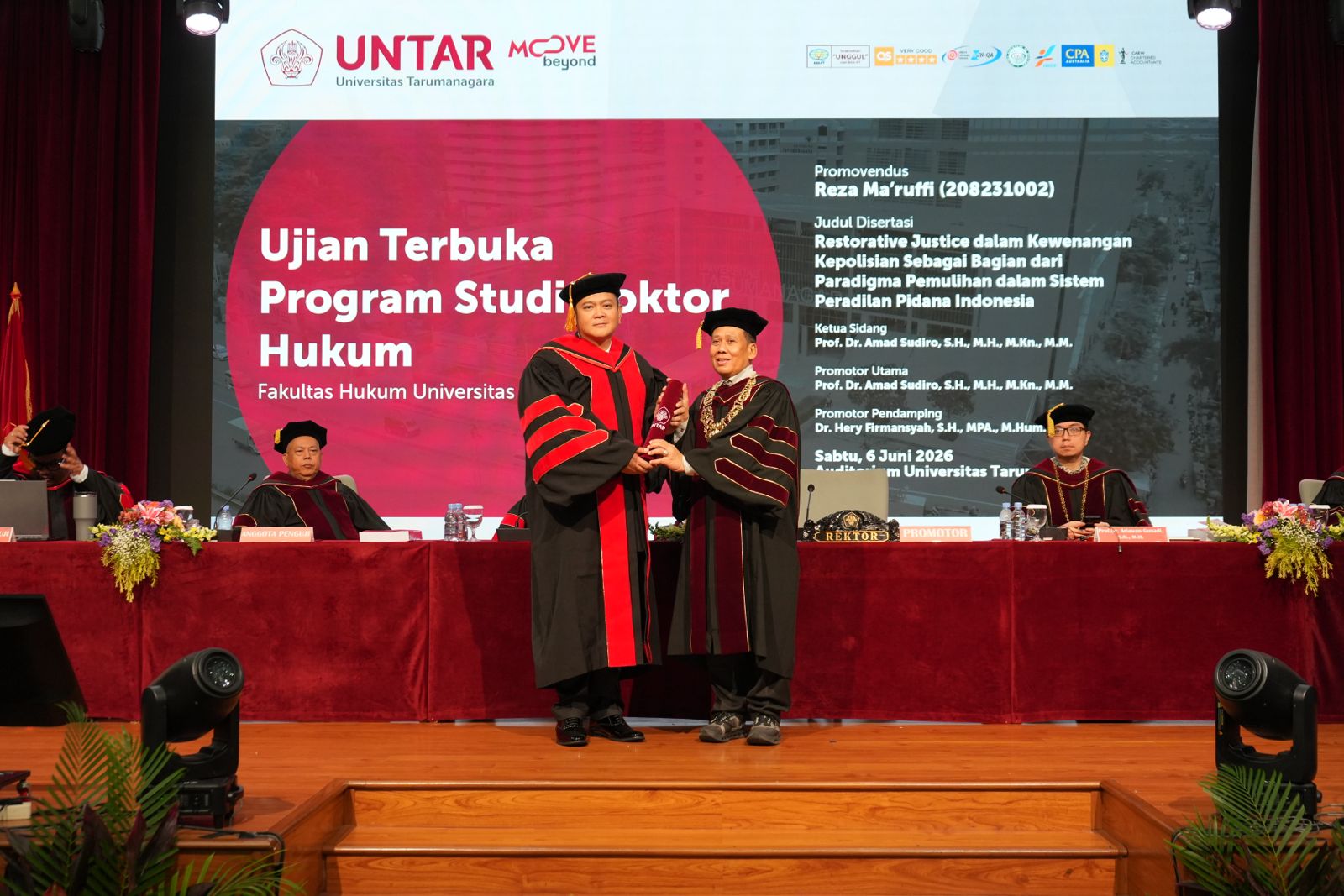
Source: Untar Public Relations – VC
“The changing paradigm of criminal law enforcement in Indonesia demands a more humane, participatory, and recovery-oriented approach. In this context, the concept of restorative justice is positioned as an alternative to the retributive approach that has long dominated the criminal justice system,” stated promovendus Reza Ma’ruffi during an open doctoral defense held by the Doctoral Program in Law at Untar on Saturday (06/06/2026) at Untar Campus I.
On the occasion, Dr. Reza Ma’ruffi, who currently serves as Head of Intelligence and Security Unit (Kasat Intelkam) of the West Jakarta Metro Police, Polda Metro Jaya (IIIA2), successfully defended his dissertation entitled “Restorative Justice within Police Authority as Part of the Recovery-Oriented Paradigm in Indonesia’s Criminal Justice System.” Dr. Reza was officially conferred as Untar’s 66th Doctor of Law during a session chaired by Untar Rector Prof. Dr. Amad Sudiro, S.H., M.H., M.Kn., M.M., who also served as the chair of the examination and the promovendus’ principal promoter.
In his presentation, the promovendus examined the authority of the Indonesian National Police in implementing restorative justice principles under Indonesia’s positive law, the normative and practical challenges in its implementation, and the ideal formulation of police authority within the framework of a recovery-oriented criminal justice paradigm for the future.
The study found that police authority to implement restorative justice has been regulated under Law No. 2 of 2002 concerning the Indonesian National Police and Police Regulation No. 8 of 2021, which provide discretionary authority for resolving criminal cases through peaceful and participatory mechanisms.
“However, its implementation continues to face normative, coordination-related, and cultural challenges. The absence of a stronger legal foundation and weak inter-agency synergy have prevented restorative justice from being implemented optimally. These conditions require stronger regulations, institutional development, and enhanced capacity among law enforcement personnel,” the newly conferred doctor explained.
Furthermore, the study emphasizes that the ideal future framework requires strengthening the role of the Police as a key actor in recovery-based dispute resolution. Such authority should be more explicitly regulated in legislation, accompanied by regulatory harmonization, human resource capacity building, community participation, and accountable external oversight. Through these measures, the Police are expected to transform from an institution that tends to rely on a repressive approach into a facilitator of social recovery within a criminal justice system that upholds justice and respects human rights. (VC/YS)