



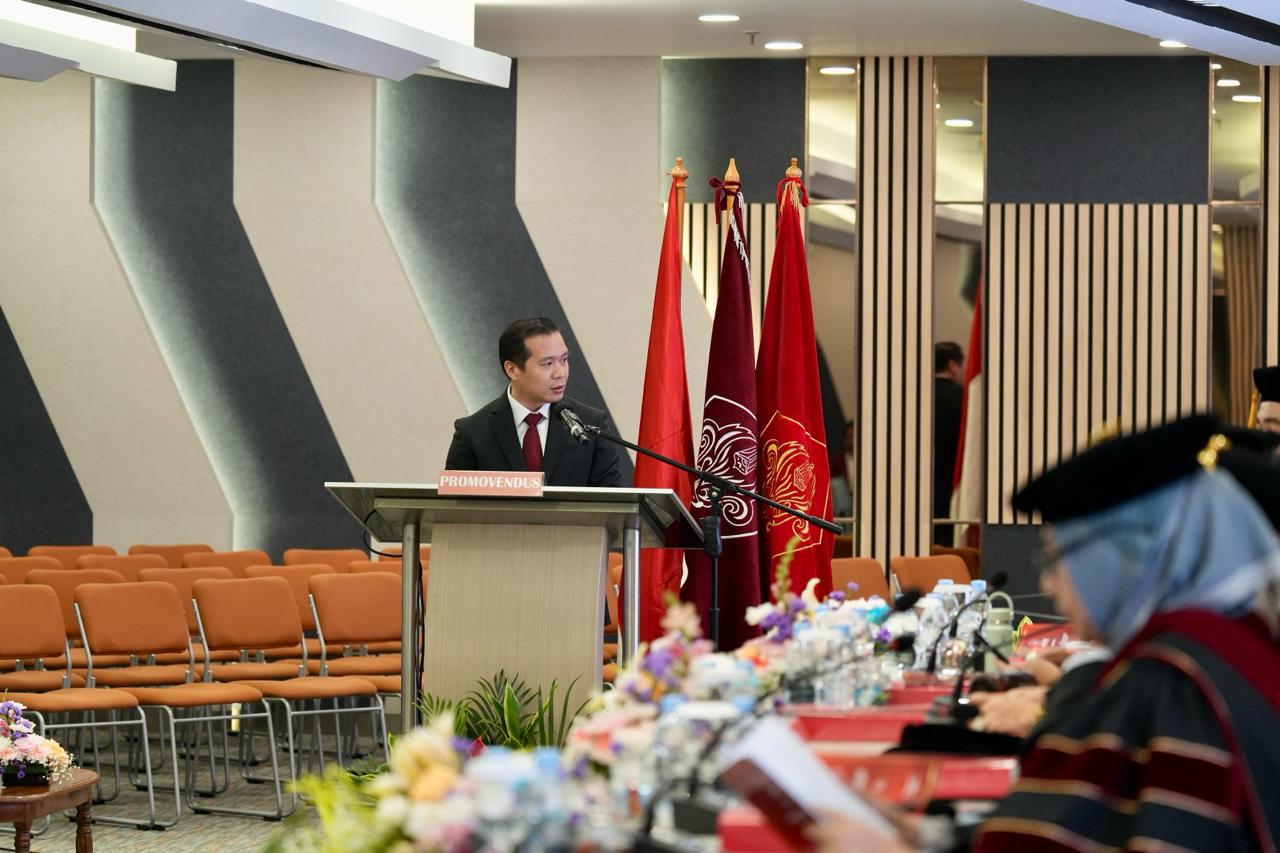
Source: Untar Public Relations
The dynamics of criminal law enforcement in Indonesia are currently in a crucial transitional phase, marked by the shift from the old colonial-era Criminal Code (KUHP) to the new national Criminal Code. This transformation is not merely normative in nature but also reflects a paradigm shift in criminal justice that emphasizes substantive justice, humanitarian values, and the protection of human rights. In the context of narcotics law enforcement, challenges remain, particularly in clearly distinguishing the legal positions of addicts, victims, and drug traffickers, which often results in injustice in law enforcement practices.
This issue formed the basis of Steven Chang’s dissertation titled “Law Enforcement Based on the Principle of Justice for Drug Addicts and Victims of Narcotics Abuse” in the Open Examination of the Doctoral Program in Law at Universitas Tarumanagara (Untar) on Friday (05/06/2026) at Campus I of Untar.
In his research, Steven examined law enforcement practices concerning narcotics abuse, which have largely been repressive in nature and have not consistently differentiated drug addicts as victims from perpetrators of illicit drug trafficking. This condition has created issues of justice, particularly for addicts who should receive a rehabilitative approach.
The study employed a normative juridical legal research method with descriptive-analytical specifications. The research utilized secondary data through statutory, conceptual, and comparative approaches and was analyzed deductively. The findings indicate that differing interpretations of Articles 54, 103, and 127 of Law No. 35 of 2009 on Narcotics have led to disparities in law enforcement, where drug addicts are often treated as criminal offenders rather than victims in need of rehabilitation.
Furthermore, these differing interpretations have contributed to legal uncertainty and created room for repressive approaches that risk overlooking principles of justice and human rights. Therefore, the study highlights the need for normative harmonization and systematic, progressive interpretation so that narcotics law enforcement can become more oriented toward humanistic and rehabilitative approaches.
As an intellectual contribution, the dissertation proposes a justice-based law enforcement model that positions addicts as subjects of rehabilitation, strengthens the role of the Integrated Assessment Team, and promotes the development of restorative and rehabilitative justice approaches, including the establishment of a Drug Treatment Court within Indonesia’s criminal justice system.
In the examination, chaired by the Rector of Untar, Prof. Dr. Amad Sudiro, S.H., M.H., M.Kn., M.M., Steven officially became the 64th graduate of the Doctoral Program in Law at Untar, earning a perfect Grade Point Average (GPA) of 4.00 and graduating with cum laude honors. The promoter of the research was Prof. Dr. Ariawan Gunadi, S.H., M.H. (CS/YS)