



Source: Untar Public Relations – CS
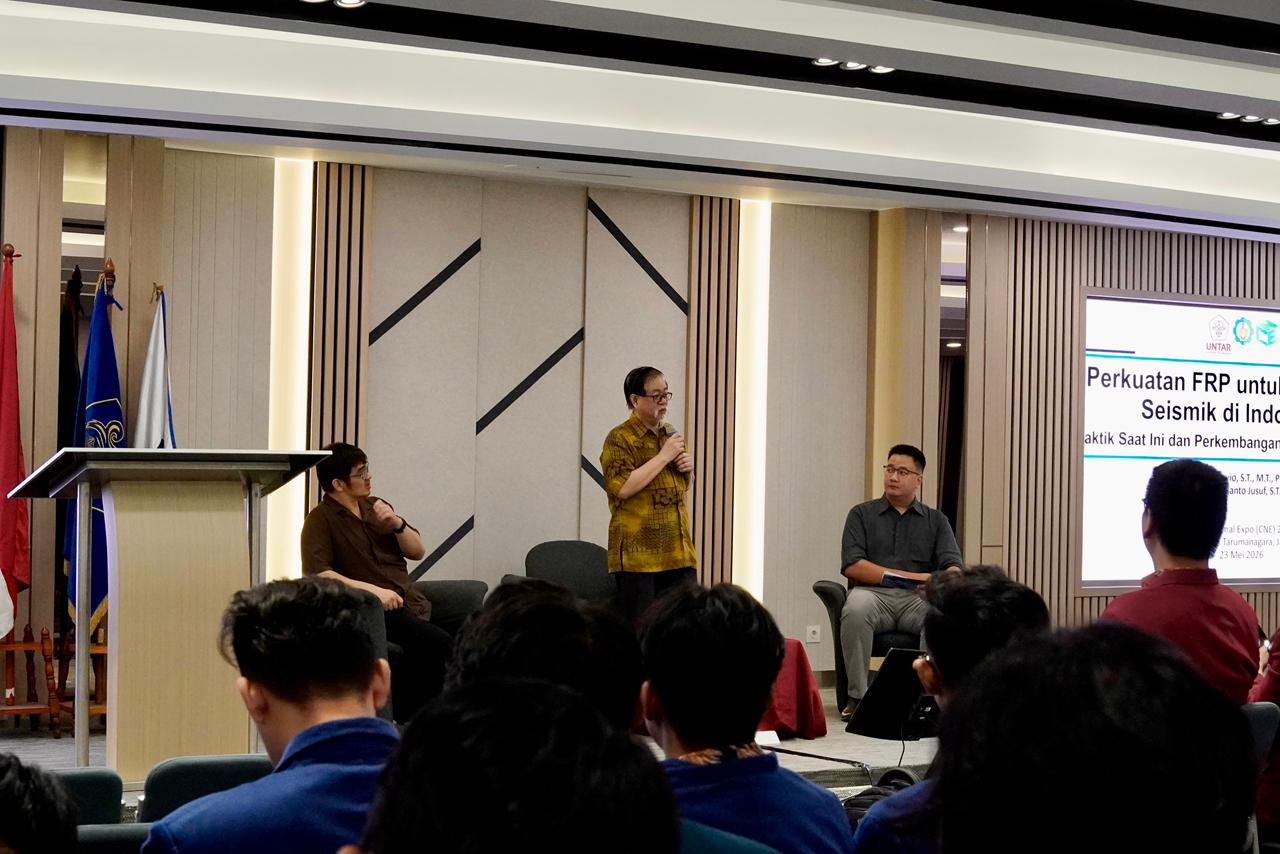
The use of fiber-reinforced polymer (FRP) technology is considered one of the potential solutions to strengthen the earthquake resilience of buildings in Indonesia. This was conveyed by Prof. Ir. Tavio, S.T., M.T., Ph.D., IPU., ASEAN Eng., ACPE., APEC Eng. during a national seminar held as part of the Civil National Expo (CNE) 2026 organized by the Tarumanagara Civil Engineering Student Association (IMASTA) at Campus I of Universitas Tarumanagara (Untar) on Saturday (23/05/2026).
Presenting the topic “FRP Strengthening for Seismic Resilience in Indonesia: Current Practices and the Development of Sustainable Solutions,” the professor from the Department of Civil Engineering at Institut Teknologi Sepuluh Nopember explained that Indonesia faces a high earthquake risk because it is located within the Ring of Fire. As a result, many public buildings such as schools, hospitals, and bridges require special attention regarding structural resilience. According to him, strengthening or retrofitting existing buildings is an important step in reducing the risk of damage during earthquakes.
One of the technologies considered promising is the use of fiber-reinforced polymer (FRP). FRP is a structural reinforcement material regarded as lighter, stronger, and more effective in improving building resilience against disasters.
“FRP will be most effective when implemented as part of a retrofit workflow that begins with assessment, determination of performance targets, code-based design, and disciplined field execution,” he explained.
He also added that the development of FRP technology in Indonesia continues to progress, particularly in research agendas related to design calibration, material durability in tropical climates, the development of low-carbon systems, and the formulation of national seismic retrofit guidelines.
In addition to academics, the seminar also featured practitioner Ir. Anwar Susanto, S.T., M.T., who presented material titled “Introduction to GFRP as a Substitute for Flexural Reinforcement in Slabs.” During the session, participants were introduced to the use of glass fiber-reinforced polymer (GFRP) as an alternative construction material that is more corrosion-resistant and supportive of sustainable development.
Chair of the Tarumanagara Civil Engineering Student Association, Marcellino Nicholas Adam, expressed hope that CNE would continue to serve as a platform for the development of Indonesian civil engineering students. “We hope students can continue to grow, collaborate, and create innovations that provide tangible contributions to national development and the advancement of the construction industry in Indonesia,” he stated.
The event was also attended by the Head of the Undergraduate Civil Engineering Program of Untar, Dr. Ir. Daniel Christianto, S.T., M.T., IPM.; Secretary of the Undergraduate, Master’s, and Doctoral Civil Engineering Programs of Untar, Ir. Yenny Untari Liucius, S.T., M.T.; as well as lecturers, students, and public participants from various universities across Indonesia.