



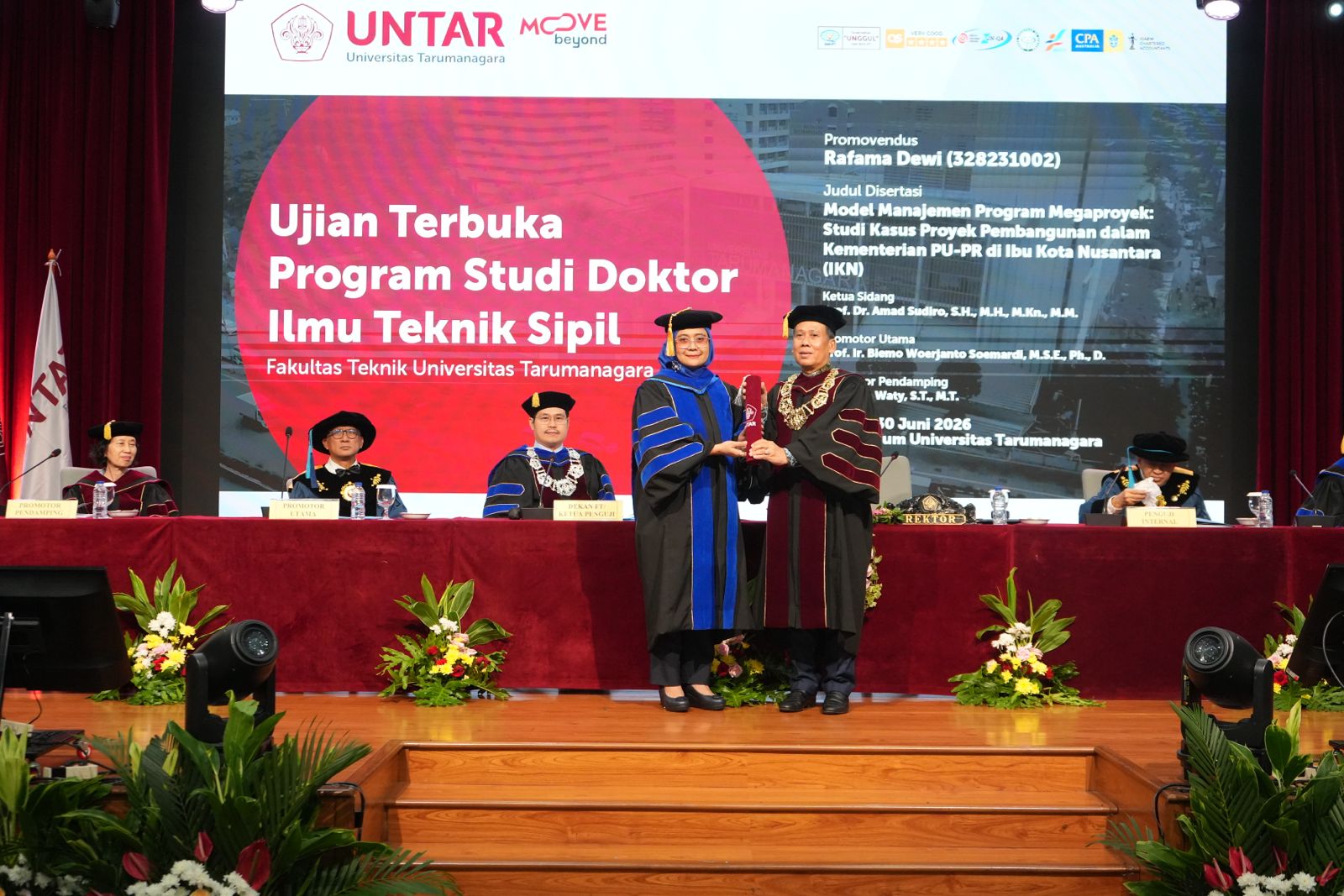
Source: Untar Public Relations – VC
Inter-agency coordination and risk management are the two most critical factors determining the success of megaproject management. In contrast, project benefit tracking remains frequently overlooked, while resource management has yet to demonstrate a direct impact on program performance.
These findings were presented by Rafama Dewi during the open dissertation examination of the Doctor of Civil Engineering Study Program at Universitas Tarumanagara (Untar) on Tuesday (30/6/2026), where she defended her dissertation titled Model Manajemen Program Megaproyek: Studi Kasus Proyek Pembangunan dalam Kementerian PU-PKP di Ibu Kota Nusantara (IKN) (Megaproject Program Management Model: A Case Study of Development Projects under the Ministry of Public Works and Public Housing in the Nusantara Capital City).
“Through this research, I propose an adaptive program management model capable of addressing the complexities of megaproject management, particularly in terms of coordination, resource allocation, benefit tracking, and risk management, so that project implementation can be carried out more effectively,” she said.
The study was motivated by the complexity of managing megaprojects, which involve numerous stakeholders, substantial resources, and high levels of uncertainty. These conditions require a more adaptive management approach than conventional models to ensure more effective program implementation while maximizing project benefits.
To validate the proposed model, Rafama employed a mixed-methods approach. Quantitative analysis was conducted using Partial Least Squares–Structural Equation Modeling (PLS-SEM), while qualitative analysis was carried out through interviews processed using NVivo 15 software.
The findings indicate that coordination and risk management have a significant positive effect on improving program performance. Meanwhile, resource allocation exerts only an indirect influence, and benefit tracking has yet to become a primary focus in megaproject implementation.
Based on these findings, Rafama developed an Adaptive Program Management Model that positions a task force (Satgas) as the coordinating mechanism connecting resource allocation, benefit tracking, and risk management through a continuous feedback process. The model is expected to enhance organizational capability in responding to changes throughout the implementation of megaprojects.
The research also found that suboptimal communication, ineffective resource distribution, and weak benefit evaluation remain key challenges in megaproject management. Therefore, the proposed model is expected to broaden program management practices by shifting from conventional approaches toward a more adaptive model that is better suited for large-scale projects in developing countries.
During the dissertation examination, chaired by Untar Rector Prof. Dr. Amad Sudiro, S.H., M.H., M.Kn., M.M., Rafama successfully defended her dissertation and was officially conferred the degree of Doctor of Civil Engineering as Untar’s 113th doctoral graduate. She currently serves as Director of PT Manajemen Konstruksi Mapronesia, a position she has held since 2014. She is also a full-time lecturer in the Civil Engineering Study Program, Faculty of Applied Science and Technology, Institut Sains dan Teknologi Nasional Jakarta. (VC/YS)