



Source: Pusdiklat Untar
Advances in health science and technology must be accompanied by ethical responsibility, particularly in protecting the rights, safety, and dignity of human participants involved in research.
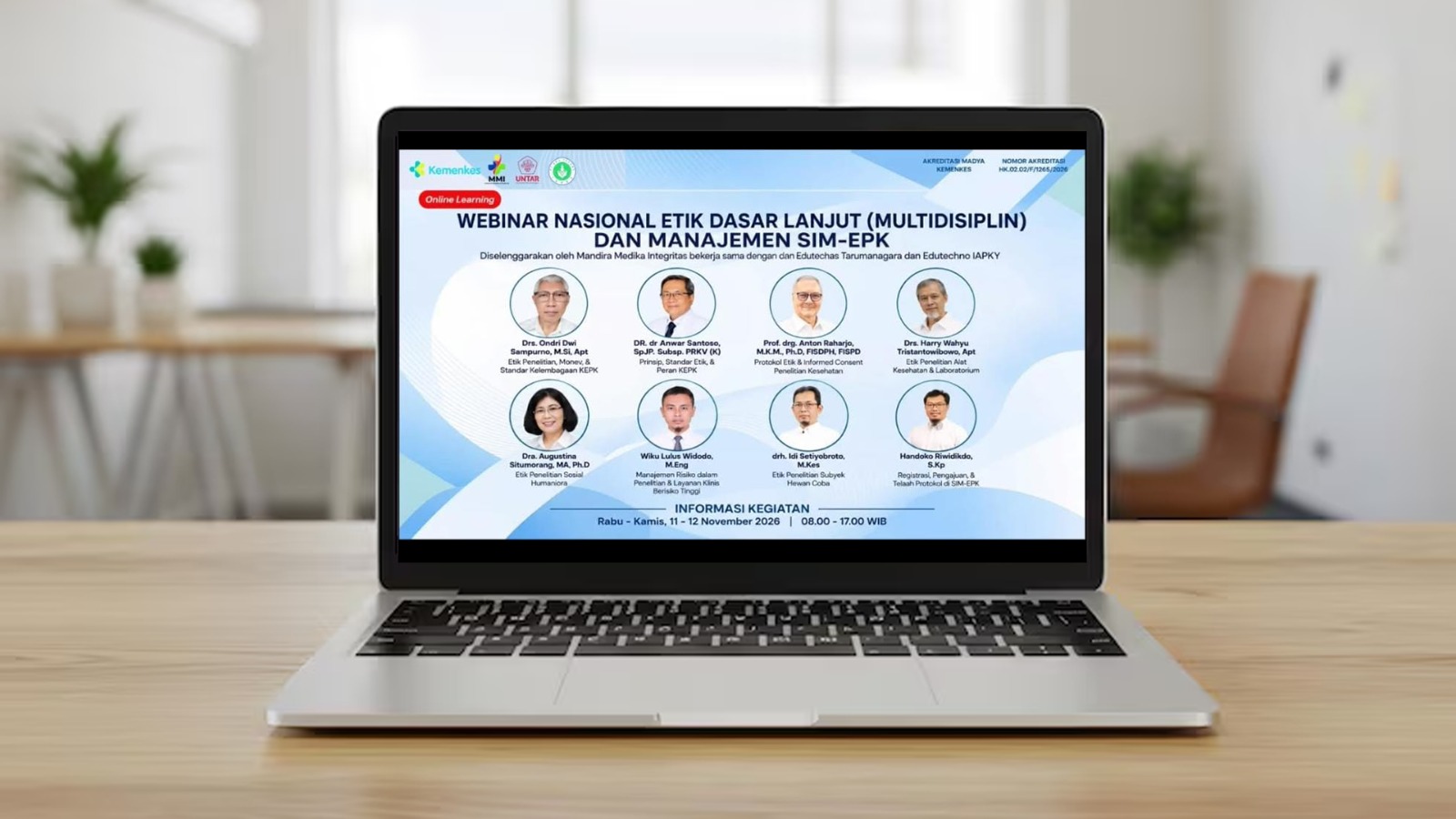
The importance of these principles was highlighted in the National Webinar on Advanced Basic Ethics (Multidisciplinary) and the Management of the Health Research Ethics Information Management System (SIM-EPK). The webinar was organized by the Center for Education and Training (Pusdiklat) of Universitas Tarumanagara (Untar), in collaboration with Mandira Medika Integritas and Edutechno IAPKY, and held online on November 11–12, 2026.
Director of Mandira Medika Integritas Dr. dr. Bondan Agus Suryanto, S.E., M.A., Sp.DLP., AAK., emphasized that progress in health research should not be measured solely by its scientific findings but also by the application of ethical principles at every stage of the research process.
“Research is expected not only to produce scientific findings but also to respect the rights, safety, dignity, and interests of human beings as research participants,” he said.
According to Bondan, ethical research management requires an understanding of multiple disciplines and a well-established management system. Research processes must also be supervised by a Health Research Ethics Committee (KEPK) to ensure the protection of individuals participating in research.
He emphasized that research ethics are not merely an administrative requirement but a foundation for building and maintaining public trust in science.
Untar Rector Prof. Dr. Amad Sudiro, S.H., M.H., M.Kn., M.M., welcomed the webinar, which integrated an understanding of ethical principles with the use of technology in research management.
According to him, the growing involvement of multiple disciplines in research requires a broader understanding of research ethics. Researchers therefore need to understand not only ethical principles and standards but also research management and oversight mechanisms.
“This multidisciplinary approach is highly relevant because today’s research challenges increasingly cross disciplinary boundaries. Understanding the management of SIM-EPK will also help make the ethical review process more orderly, transparent, and efficient,” Amad said.
The webinar covered several important aspects, including research ethics principles and standards, protocol development, informed consent, ethics in social sciences and humanities research, medical device and laboratory research, and risk management in high-risk research.
Participants also gained an understanding of the role of the National Committee for Health Research and Development Ethics (KEPPKN), particularly in providing guidance, monitoring, and evaluating KEPKs, including institutional standards and ethics committee accreditation.
In addition to conceptual discussions, the event introduced the management of SIM-EPK, a digital-based system that facilitates online submissions and ethical reviews of health research.
The use of this system is expected to improve the effectiveness, transparency, and accountability of ethical review processes while supporting better research governance.
The webinar was also attended by Head of Untar’s Center for Education and Training and Chair of the Organizing Committee Dr. dr. Arlends Chris, M.Si., Sp.KKLP., AHK.; Head of Untar’s Institute for Research and Community Engagement (LPPM) Dr. Hetty Karunia Tunjungsari, S.E., M.Si.; as well as representatives of KEPPKN, IAPKY, and participants from various backgrounds.
Through this event, Untar and its partners seek to strengthen a research culture that not only focuses on scientific advancement but also upholds ethical principles and the protection of human participants. (CJ/YS)