



Source: Untar Public Relations – VC
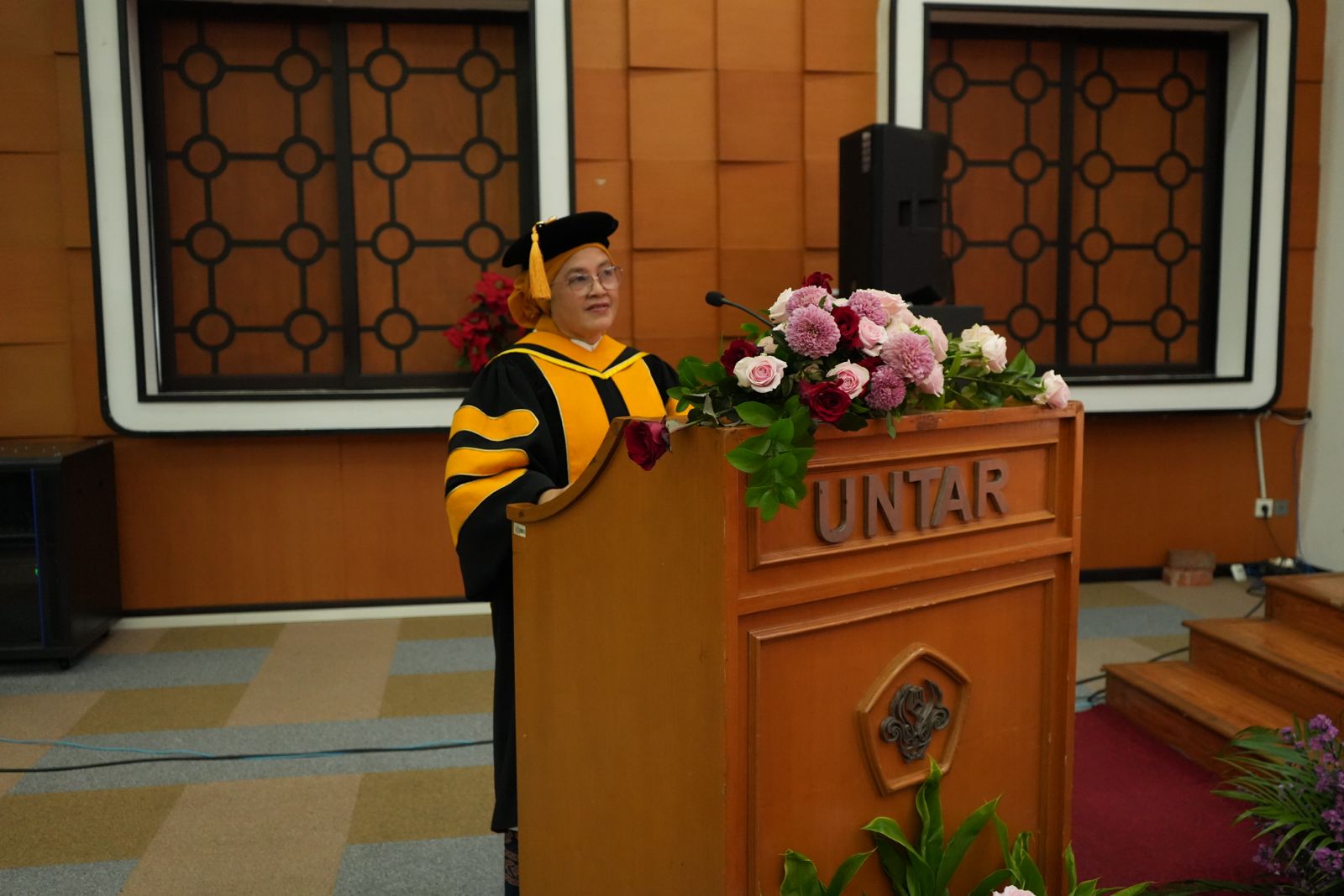
The Doctor of Management Science Study Program at Untar held an open doctoral examination on Friday (24/04/2026) at Untar Campus I. On this occasion, Kartika Nuringsih officially earned a doctoral degree as the 23rd graduate of the program after being declared to have passed with the distinction of highly satisfactory. The graduation was formally confirmed by Rector of Untar, Prof. Dr. Amad Sudiro, S.H., M.H., M.Kn., M.M.
The open examination was attended by university leaders and the board of examiners. Prof. Dr. Haris Maupa, S.E., M.Si. served as the Main Promoter, accompanied by Co-Promoter Prof. Dr. Muhammad Idrus Taba, S.E., M.Si. The internal examiners consisted of Prof. Dr. Ir. Agustinus Purna Trawan, M.T., M.M., IPU., A.E.; Prof. Dr. Sawidji Widoatmodjo, S.E., M.M., M.B.A.; and Dr. Sarwo Edi Handoyo, S.E., M.M. Meanwhile, the external examiner was Prof. Dr. Indrianty Sudirman, S.E., M.Si.
In her dissertation, Dr. Kartika Nuringsih examined the topic “Determinants of Sustainable Entrepreneurial Intention among Business Actors in Kulon Progo Regency, Special Region of Yogyakarta.” The research focused on entrepreneurial activities in the region, including the innovative “Bela-Beli Kulon Progo” policy as a form of strengthening the local economy. The study emphasized the importance of entrepreneurial management that considers sustainability aspects through an understanding of sustainable entrepreneurial intention.
In her presentation, Dr. Kartika Nuringsih explained efforts to foster sustainable entrepreneurial intention through the perception of corporate social responsibility (CSR) support as a mediating variable. “The variable mediates the influence of entrepreneurial passion, local culture, and network capability on sustainable entrepreneurial intention (SEIN). The research approach used was quantitative, supported by qualitative descriptive analysis,” she explained during the open examination.
The research data were obtained from respondents consisting of micro and small business owners, cooperatives, and village-owned enterprises using purposive sampling techniques. In the research model, perceived CSR support acted as the mediating variable, while entrepreneurial passion, local culture, and network capability functioned as exogenous variables, with SEIN serving as the endogenous variable.
The findings showed that local culture had a significant positive effect on CSR support, but did not significantly influence SEIN. Network capability had a significant positive effect on both CSR support and SEIN, although the mediating effect of CSR was not significant. Meanwhile, perceived CSR support was proven to have a significant positive effect on SEIN, despite its relatively weak role in mediating entrepreneurial passion and local culture.
As a novelty, the study adapted indicators of SEIN, perceived CSR support, local culture, and entrepreneurial passion within the context of sustainable entrepreneurship. The results of this research are expected to serve as a reference for relevant institutions in formulating policies for sustainable entrepreneurial development. (VC/YS)