



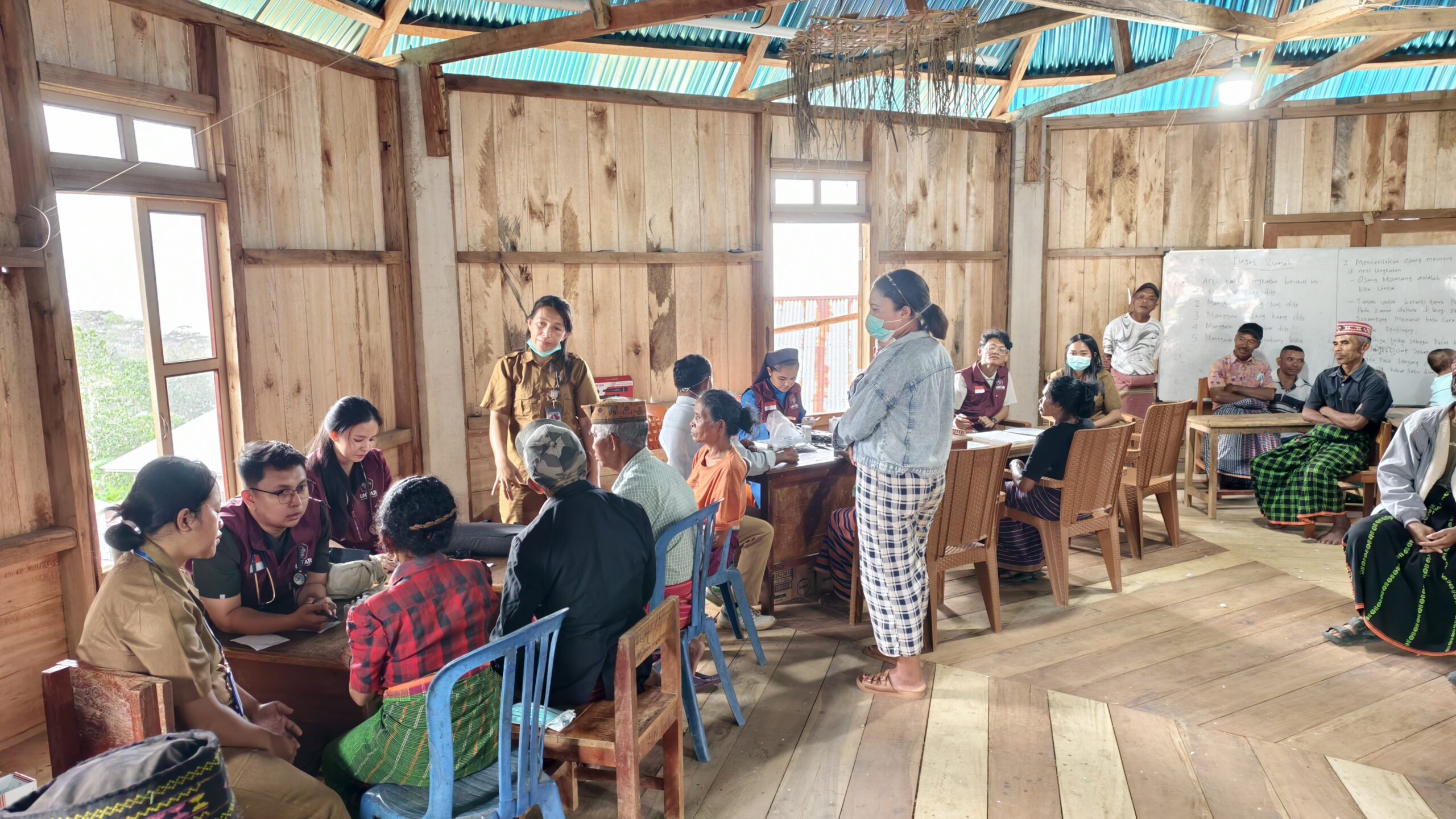
Universitas Tarumanagara (Untar) provided healthcare services and psychosocial support to communities affected by an earthquake in Manggarai Regency, East Nusa Tenggara (NTT), from September 28–30, 2026. The initiative was part of efforts to support the physical and psychological recovery of communities following the disaster.
The community service program, coordinated by the Higher Education Service Institute (LLDikti) Region III, involved lecturers, students, and alumni from Untar’s Faculty of Medicine (FK) and Faculty of Psychology (FPsi), with support from Untar’s Institute for Research and Community Engagement (LPPM).
Services were provided in several areas, including Pongleko, Bea Mese, and the working area of Lao Community Health Center (Puskesmas Lao). The Untar team integrated medical examinations with psychosocial support to address the needs of disaster-affected communities.
In Pongleko, the Untar Faculty of Medicine team provided healthcare services to 136 patients with various complaints, including digestive disorders, coughs, colds, and anemia. The examinations aimed to address existing health concerns while preventing the deterioration of conditions that residents had experienced even before the disaster.
Meanwhile, the Untar Faculty of Psychology team provided psychosocial support to 90 residents. Through consultations and observation, residents were given an opportunity to share their experiences, concerns, and emotional challenges following the earthquake.
This support was an important part of the recovery process, as the impact of a disaster extends beyond physical conditions and can also affect the psychological well-being of communities.
The Untar team’s presence was also appreciated by the Manggarai Regency Health Office. Andi Jemahu, spokesperson for the Health Emergency Operation Center (HEOC) post at the Manggarai Regency Health Office, noted that the involvement of the Untar Faculty of Psychology team alongside other volunteers provided moral support and strengthened the region’s health system preparedness in addressing the psychosocial impact of the disaster.
When sending off the community service team earlier, Untar Vice Rector Assoc. Prof. Sri Tiatri, S.Psi., M.Si., Ph.D., Psikolog, emphasized the importance of applying academic expertise to address community needs. “Higher education institutions must provide benefits that communities can directly experience. Through this initiative, we hope that expertise in medicine and psychology can help disaster-affected communities recover, both physically and psychologically,” she said.
Efforts to improve access to healthcare were also implemented in the Lao area. The Untar team conducted medical examinations at the neighborhood head’s residence to make services more accessible, particularly for older residents.
A total of 48 residents received healthcare services through this approach. The initiative highlighted the importance of adapting services to community conditions, especially for groups with limited mobility.
Collaboration between the medical and psychology teams enabled physical and psychological health needs to be addressed in an integrated manner based on residents’ circumstances.
Local community representatives expressed their appreciation for the services provided by the Untar team. The presence of medical personnel and psychosocial support workers helped residents access health examinations while receiving support in coping with post-disaster conditions.
“These services have been very helpful to residents, especially older people who have difficulty reaching healthcare facilities. We hope initiatives like this can continue because the community can directly feel their benefits,” the representative said.
The activities in Manggarai continue Untar’s involvement in supporting disaster-affected communities in various regions. Previously, Untar provided humanitarian assistance and healthcare services to victims of the 2022 Cianjur earthquake, as well as communities affected by disasters in West Sumatra in 2025 and Tegal in 2026.
Through its activities in Manggarai, knowledge and expertise developed in the academic environment were applied directly to help communities address real-world challenges. The involvement of lecturers, students, and alumni also reinforces the role of higher education institutions in supporting post-disaster recovery. (CJ/YS)