



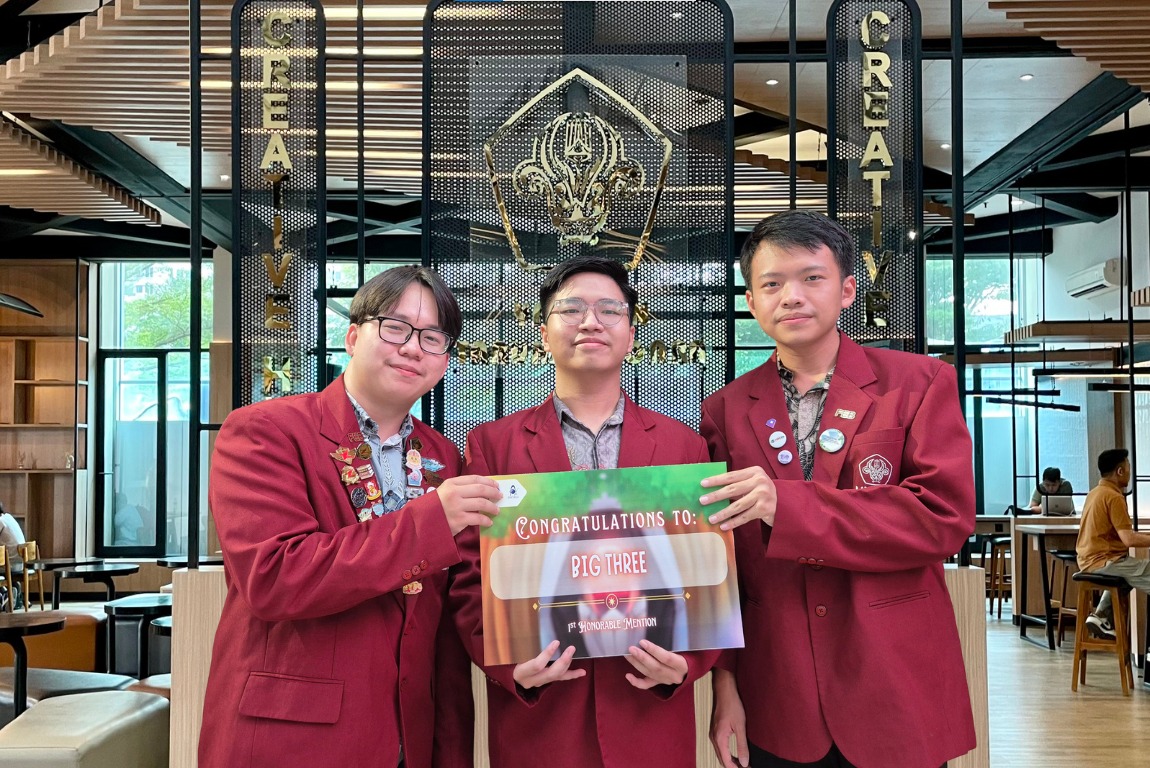
Source: Business Accounting Students
Three students from the Business Accounting Study Program, Faculty of Economics and Business, Universitas Tarumanagara (Untar), developed strategies to reduce carbon emissions across Indonesia’s dairy supply chain. Their strategies were designed by considering global companies’ emission management practices as well as the conditions and capabilities of smallholder farmers in Indonesia.
Their research earned Enrico Joseph Immanuel Winata, Eric Bryan Lie, and Richard Edbert First Runner-Up (Honorable Mention) in the international competition The Accounting Ultimate Challenge (ATIC 10). Organized by the Accounting Student Association of Universitas Multimedia Nusantara, the competition was held online on October 31, 2026.
In their research titled “Feasible Pathways for a Low-Carbon Dairy Supply Chain in Indonesia: Insights from Global Comparisons,” the three students compared carbon emission reporting and mitigation practices at global dairy companies Lactalis and FrieslandCampina with those of two Indonesian companies, Cimory and Ultrajaya.
Through a systematic literature review and comparative analysis, the team identified several challenges in managing indirect emissions originating from livestock activities, feed production, and waste management.
Based on their findings, the team developed emission reduction strategies in three stages. In the short term, companies can improve energy efficiency and conduct carbon emission inventories through their accounting departments.
For the medium term, the team proposed joint investments in developing technology to process livestock waste into biogas through anaerobic digestion.
For the long term, the team recommended using the local forage plant Indigofera zollingeriana and feed additives to reduce methane emissions. The research also proposed utilizing financing instruments through Indonesia’s carbon exchange, IDXCarbon.
One of the team members, Eric Bryan Lie, said the research allowed students to deepen their understanding of sustainability and carbon accounting.
“Through this competition, we not only learned about the structure of scientific writing but also gained a deeper understanding of the application of sustainability and carbon accounting,” he said.
According to Eric, the research process also taught the team the importance of collaboration and time management, particularly in balancing academic activities with competition preparations.
The recommendations developed in the research cover operational, technological, and financing aspects while taking into account the ability of smallholder farmers to implement carbon emission reduction strategies. (CS/YS)